
Can richer messaging make healthcare communication more effective?
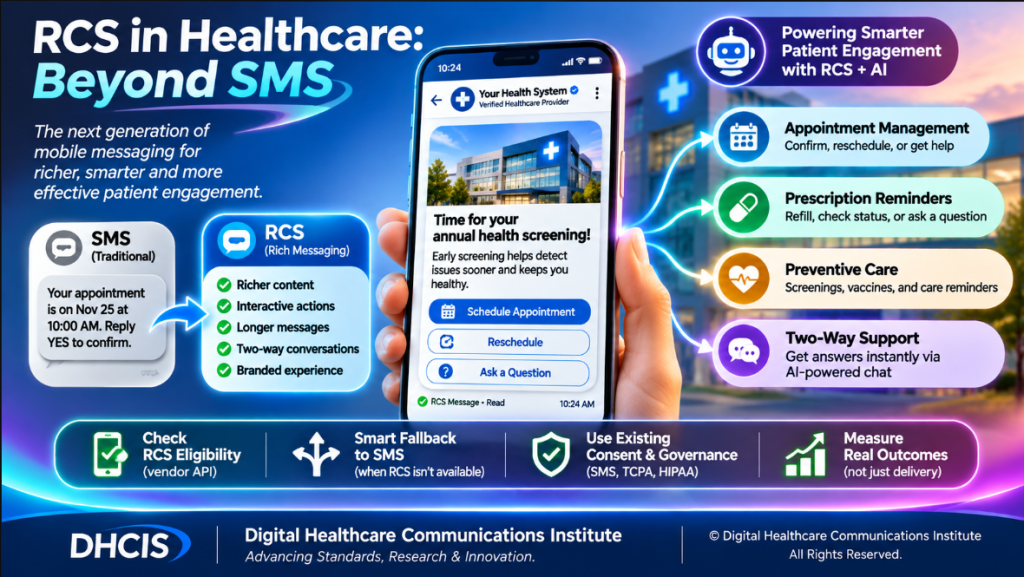
SMS has been one of the most widely used communication channels for years. It’s simple, familiar, and works across almost every mobile phone.
But as healthcare communication continues to evolve, is traditional SMS enough to meet growing patient expectations?
This is where Rich Communication Services, commonly known as RCS, comes into the picture.
RCS is a newer generation of mobile messaging that builds upon traditional SMS capabilities. It allows organizations to move beyond plain text and create richer, more interactive communication experiences.
Images, GIFs, interactive buttons, branded messaging, longer messages, and two-way conversations are some of the capabilities RCS can offer.
But the real opportunity isn’t simply making messages look more attractive.
It’s about making healthcare communication more interactive, intelligent, and effective.
1. Moving Beyond the Limitations of SMS
Traditional SMS has served healthcare organizations well.
Appointment reminders, prescription notifications, health alerts, and other important communications can be delivered quickly without requiring patients to download another application.
However, SMS has limitations.
A standard SMS segment supports 160 characters with basic GSM encoding, with lower limits for certain special characters and longer concatenated messages.
It also offers limited native interactivity.
RCS addresses many of these limitations.
Imagine receiving an appointment reminder that allows you to confirm, reschedule, or request assistance directly from the message.
Or a prescription notification that provides an interactive option to check refill status.
Instead of asking patients to navigate through multiple applications or websites, organizations can bring certain actions directly into the messaging experience.
The value of RCS isn’t just in what a message can display, but in what it enables the patient to do.
2. Intelligent Communication Starts With Better Interaction
One of the interesting capabilities of RCS is the additional information it can provide about message interactions.
Depending on the platform and device, organizations may have access to richer delivery and read-status information, button selections, and conversational responses.
This creates opportunities to better understand how patients interact with communications.
And when these capabilities are combined with AI, the possibilities become even more interesting.
For example, an RCS chatbot could help patients navigate common questions, identify the type of assistance they need, or guide them toward an appropriate next step.
AI could also help organizations analyze interaction patterns, identify where patients encounter difficulties, and improve future communications.
But we need to be thoughtful about how these capabilities are implemented.
Healthcare communication often involves sensitive information. AI-powered interactions require appropriate privacy safeguards, security controls, and clear boundaries around what automated systems should handle.
The objective shouldn’t be to automate every conversation.
It should be to make communication easier for patients while ensuring they receive appropriate assistance when they need it.
3. RCS Adoption Requires a Practical Delivery Strategy
Despite its capabilities, RCS isn’t universally available.
Device compatibility, operating system support, carrier availability, messaging applications, and other technical conditions can affect whether a patient can receive an RCS message.
Although support has expanded across major mobile ecosystems and carriers, organizations cannot assume that every mobile number is RCS-enabled.
This is where a well-designed communication platform becomes important.
Before sending a message, an organization may be able to use an RCS provider’s capability-check API to determine whether the recipient supports RCS.
If RCS isn’t supported, the platform can route the communication through traditional SMS, where permitted.
Similarly, if an RCS message cannot be delivered, an appropriately designed fallback process can attempt delivery through SMS.
The exact fallback behavior depends on the vendor, failure reason, and configuration.
This approach allows organizations to introduce newer communication capabilities without compromising the reach that traditional SMS provides.
Providers such as Infobip and Twilio offer RCS-related messaging capabilities, including support for interactive experiences and conversational workflows, although available features vary.
The goal should never be to force patients onto a newer channel. It should be to reach them through the most appropriate supported channel.
4. Innovation Must Work Within Existing Governance
Introducing a new communication channel doesn’t eliminate existing regulatory responsibilities.
Healthcare organizations must continue to consider consent, privacy, security, and applicable communication regulations.
In many cases, existing SMS consent-management processes, preference controls, and governance frameworks can provide a useful foundation for RCS.
For example, organizations may be able to extend their established consent validation and communication eligibility checks to support RCS.
However, that doesn’t mean RCS can automatically inherit every SMS consent permission or that no additional review is necessary.
Applicable TCPA requirements, HIPAA obligations, carrier and platform policies, vendor arrangements, and the nature of the communication must still be evaluated.
This is particularly important when messages involve protected health information or conversational interactions.
Organizations should build upon existing governance wherever appropriate, rather than unnecessarily duplicating processes.
But innovation should never come at the expense of patient privacy or trust.
5. RCS Should Be About Better Outcomes, Not Just Better-Looking Messages
RCS presents an exciting opportunity for healthcare communication.
It can support richer content, more interactive experiences, conversational workflows, and potentially better insight into patient engagement.
But we should be careful not to evaluate its success only through delivery rates, read receipts, or the number of interactions generated.
The same question we ask of every healthcare communication channel applies here.
Did the communication actually help the patient?
Did it make scheduling an appointment easier? Did it reduce the effort required to complete a task? Did it help patients find information or assistance more quickly?
These are the outcomes that matter.
As RCS adoption continues to grow, healthcare organizations have an opportunity to rethink how mobile messaging fits into the broader patient journey.
SMS will continue to play an important role because of its simplicity and reach. RCS can complement it by offering richer experiences where supported.
And AI can potentially make those experiences more intelligent and responsive.
But none of these technologies should be viewed as the final objective.
The objective is better healthcare communication. RCS is another powerful way to help us get there.


Leave a Reply