
Are we measuring communication effectiveness, or simply our ability to deliver messages?
Healthcare communication exists for a reason.
Whether it’s an appointment reminder, a prescription notification, a preventive care recommendation, or an important health update, every communication should serve a purpose.
And if there is a purpose, shouldn’t we also be measuring whether that purpose was achieved?
Today, healthcare organizations have sophisticated communication platforms capable of delivering millions of messages across multiple channels.
We can track delivery rates, open rates, click-through rates, and several other engagement metrics.
But here’s the question.
Are these metrics really telling us how effective our healthcare communications are?
I believe they are only telling us part of the story.
1. Delivery Is Only Half the Job
Let’s consider a simple example.
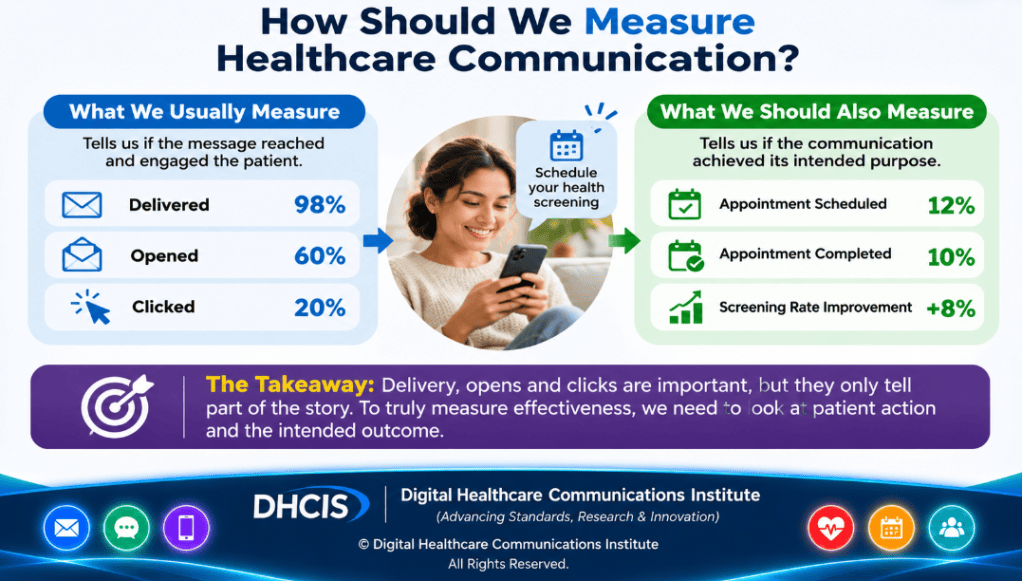
A healthcare organization sends 100,000 messages reminding patients to schedule their annual health screenings.
The campaign achieves a 98% delivery rate, a 60% open rate, and a 20% click-through rate.
From a traditional communication dashboard, these numbers might look encouraging.
But how many patients actually scheduled their screenings?
And more importantly, how many completed them?
If we don’t know the answers, can we confidently call the campaign successful?
We have measured how well the communication was distributed and how patients interacted with it.
But we haven’t measured whether it achieved its intended purpose.
If we stop measuring at delivery, we are only measuring our ability to send messages, not our ability to communicate effectively.
2. We Need to Look Beyond Traditional Engagement Metrics
The marketing industry has long recognized the importance of measuring conversions.
A customer receiving or clicking an advertisement is not necessarily the desired outcome. What matters is whether that interaction leads to the intended action.
Healthcare communication should be no different in its approach to measuring effectiveness.
Consider a few examples:
- An appointment reminder should help patients attend their appointments.
- A prescription refill notification should help patients complete their refills.
- A preventive screening reminder should encourage patients to schedule or complete their screenings.
- A registration reminder should help patients finish the required process.
In each case, delivery, opens, and clicks are useful indicators.
But the intended patient action is a much stronger measure of effectiveness.
Of course, not every healthcare communication requires an action. Some messages are purely informational, and their effectiveness may depend on whether the patient received, understood, or could use the information.
The important point is that we need to define what success means before sending the communication, rather than deciding afterward based on whichever metrics are available.
3. Without Measuring Outcomes, How Can We Optimize?
Healthcare organizations invest considerable effort in improving communication capabilities.
We experiment with message content, delivery timing, personalization, and communication channels.
But what are we actually optimizing?
If our primary measure of success is the open rate, we may end up optimizing messages to get more opens.
If we focus only on clicks, we may improve click-through rates without necessarily improving patient outcomes.
What if a message gets fewer clicks but leads to more completed appointments?
Wouldn’t that be a more effective communication?
This is why connecting communication data with relevant downstream actions is so important.
It allows organizations to understand what worked, what didn’t, and where improvements are needed.
And it helps distinguish between communication activity and communication effectiveness.
There are practical challenges, of course. Patient actions may happen through different channels, some outcomes take time, and privacy requirements must be respected when connecting data.
But these challenges shouldn’t prevent us from working toward better measurement.
Without understanding the outcome, optimization will always remain incomplete.
4. It’s Time to Redefine Communication Success
Perhaps we need to rethink how healthcare communication performance is reported.
Instead of dashboards that primarily show how many messages were sent, delivered, opened, or clicked, we should also be asking:
Did the patient take the intended action? Did the communication help reduce missed appointments? Did it make an important healthcare process easier to complete? Did it help patients understand what they needed to do?
And where possible, did the communication actually contribute to those improvements, rather than simply happen before them?
This doesn’t mean traditional communication metrics are no longer important.
Delivery, opens, and clicks help us understand different stages of the communication journey. They can also help identify technical problems and opportunities for improvement.
But they should be viewed as supporting indicators, not the final definition of success.
Healthcare communication needs a more complete measurement approach, one that connects delivery, engagement, patient action, and intended outcomes.
Because ultimately, the objective isn’t to send more messages or generate better-looking dashboards.
It’s to make healthcare communication more effective for the people receiving it.
And unless we measure that effectiveness, we are only doing half the job.


Leave a Reply