
More investment. More channels. More technology. So why aren’t we communicating better?
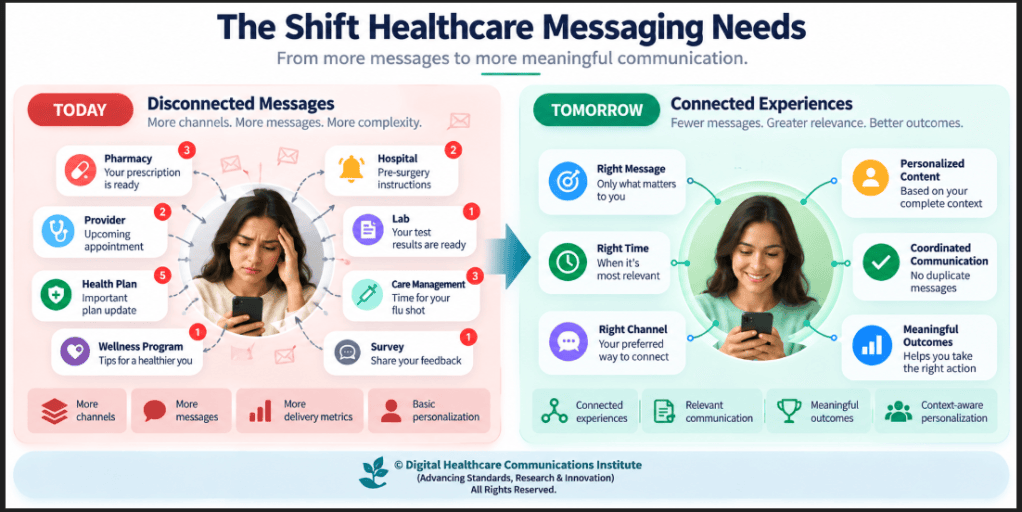
Healthcare organizations send an enormous volume of digital communications every day. With so much depending on these interactions, it is hardly surprising that organizations continue investing heavily in communication platforms, technology, people and new capabilities.
The intention is clear: make healthcare communication faster, smoother and more effective.
Yet, despite these investments, something still isn’t working the way we envisioned.
New channels and use cases continue to emerge, adding another layer of complexity to an already crowded communication ecosystem. We have more ways to reach patients and members than ever before, but that doesn’t necessarily mean we understand them any better.
Perhaps the problem isn’t how much we’re investing. It’s what we’re trying to solve.
1. More Channels, More Complexity
Every new communication channel brings exciting possibilities. SMS made communication immediate. Push notifications brought healthcare into mobile apps. RCS is introducing richer, more interactive experiences. AI is opening doors to entirely new ways of engaging with consumers.
But every new channel also brings additional decisions, systems, processes and opportunities to communicate.
Imagine a member receiving a prescription reminder, an appointment notification, a health plan update and a wellness message, all within a few hours.
Each communication may be relevant to the organization sending it. But is anyone looking at the experience of the person receiving all four?
We are continuously adding new communication capabilities without necessarily addressing the complexity we have already created.
More channels should mean more choices, not more messages.
2. Are We Measuring the Wrong Things?
One reason organizations may have a false sense of success is that we often measure what is easy to measure rather than what truly matters.
Messages sent. Delivery rates. Open rates. Click-through rates.
These are important operational metrics. They help us understand whether our platforms and campaigns are functioning as expected.
But a 99% delivery rate doesn’t necessarily mean 99% of our communications were useful.
A message can be delivered successfully and still be irrelevant, repetitive or poorly timed.
Similarly, connecting multiple channels or consolidating everything onto a single vendor may simplify operations, reduce costs and improve technical efficiency. These are meaningful achievements, but they don’t automatically translate into better communication.
Connecting systems isn’t the same as connecting experiences.
We need to complement traditional performance metrics with a better understanding of relevance, usefulness and whether our communications actually help people take action.
3. Personalization Needs a Complete Rethink
There was a time when personalization largely meant addressing someone by name, understanding their age group, identifying their location or selecting their preferred communication channel.
Those factors still matter, but they are no longer enough.
Two people of the same age, living in the same city and using the same communication channel may have completely different healthcare needs, behaviors and expectations.
Even the same person’s communication needs can change depending on their circumstances.
Modern personalization needs a much richer understanding of the individual: their preferences, previous interactions, current healthcare journey, communication behavior and immediate needs.
It should also recognize what they have already done and what they no longer need to hear.
The objective isn’t to use every piece of information we have about someone. Privacy, consent and responsible data use must remain fundamental.
Instead, we should use the appropriate information to understand what matters to that individual at that particular moment.
That’s where personalization becomes genuinely meaningful.
4. Fixing the Problem Requires a Different Approach
The solution isn’t simply another channel, a larger communication budget or a single technology vendor.
Those investments can certainly help, but only when supported by a broader communication strategy.
We need to move from managing individual messages toward understanding the entire communication experience.
That means coordinating channels, recognizing previous interactions, respecting communication preferences, reducing unnecessary messages and measuring whether our communication achieves something meaningful.
AI and emerging technologies can play an important role in making this possible at scale. But technology should support the strategy, not become the strategy itself.
Ultimately, the question is no longer how efficiently we can send millions of messages.
It’s whether those millions of messages are making healthcare simpler for the people receiving them.
Healthcare messaging isn’t broken because organizations aren’t doing enough.
The challenge is that we are investing heavily in individual capabilities without always connecting them to the bigger picture.
The future of healthcare communication won’t be defined by how many messages we can send, but by how intelligently we decide which messages are worth sending.


Leave a comment