
From Messages and Channels to Connected Healthcare Experiences
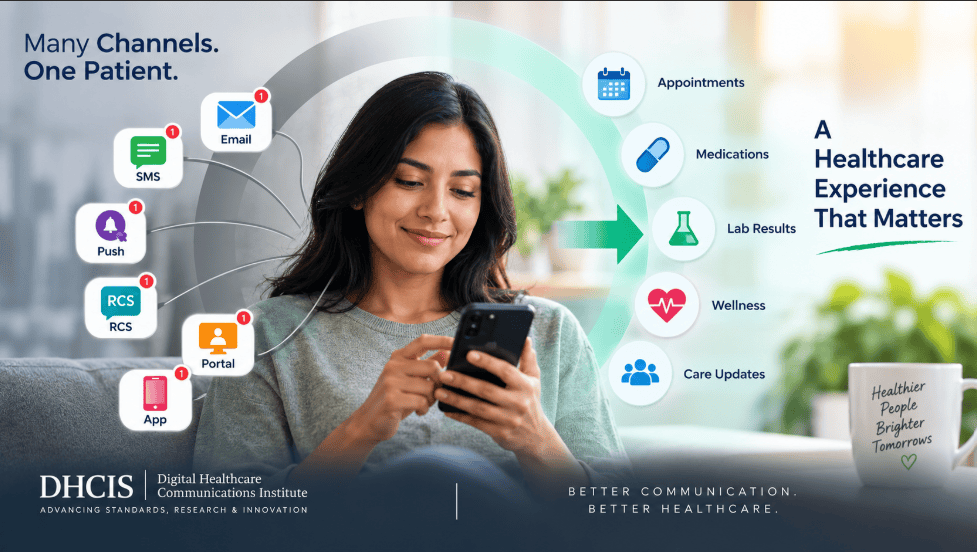
Healthcare organizations today have more ways to communicate than ever before.
Email. SMS. Push notifications. Patient portals. Apps. RCS. Automated calls.
Each new channel gives us another opportunity to reach patients and members. But after working with healthcare communications across multiple channels, I have increasingly come to believe that adding more ways to communicate does not necessarily mean we are communicating better.
There is a simple reason.
Healthcare organizations think in channels. Patients experience healthcare.
That difference matters.
The Patient Doesn’t Think in Channels
Inside an organization, communication is often divided across different platforms, teams and business areas.
A pharmacy may send a prescription reminder. A provider may send an appointment notification. A health plan may send a benefits email. An app may send a wellness notification.
Individually, every message may make perfect sense.
But to the person receiving them, they aren’t separate communication programs. They are all part of the same healthcare experience.
Imagine receiving five healthcare messages in one day from different organizations and channels. Even if every message is legitimate, the overall experience can quickly become overwhelming.
This is why I believe the next stage of digital healthcare communication needs to move beyond managing individual channels.
We need to start looking at communication through the eyes of the person receiving it.
More Communication Isn’t Always Better Communication
When a new communication channel becomes available, it is easy to see it as another opportunity to engage.
And sometimes it absolutely is.
But there is another side to that equation.
Every additional channel also creates another opportunity to send another message.
If email, SMS, push and RCS are all capable of reaching the same person, the question shouldn’t be:
“How many of these channels can we use?”
It should be:
“Which communication does this person actually need?”
That changes the thinking completely.
A prescription reminder that helps someone pick up an important medication is valuable.
Four reminders across four channels for something the person has already completed are not.
Sometimes the smartest communication decision is not choosing another channel.
It is deciding not to send another message.
More Communication Isn’t Always Better Communication
With email, SMS, push, RCS, apps and patient portals, healthcare organizations have more ways than ever to reach people.
But every new channel also creates another opportunity to send another message.
The question therefore shouldn’t be “How many channels can we use?” It should be “What does this person actually need from us right now?”
A prescription reminder that helps someone take action is valuable. Four reminders across different channels after the person has already acted are not.
The same applies to personalization. It shouldn’t simply mean adding a name or more information. Good personalization should make communication simpler, more relevant and easier to act upon.
Sometimes better communication means adding useful context.
Sometimes it means choosing a better channel.
And sometimes, the best communication decision is not sending another message at all.
Right Message. Right Channel. Right Time.
I keep coming back to this because, despite all the technology behind modern healthcare communication, the objective itself is quite simple:
Right Message. Right Channel. Right Time.
The message should be relevant. The channel should be one the person is likely to engage with. And the timing should make the communication useful.
At healthcare scale, getting all three right is not easy. Different people have different preferences, behaviors and needs. This is where data, technology and increasingly AI can help.
But technology should not make communication more complicated for the patient.
It should make the experience simpler.
Maybe We Need to Measure Something Different
For years, we have measured digital communication through familiar metrics:
Sent. Delivered. Opened. Clicked.
These metrics are important, but they don’t necessarily tell us whether we communicated well.
A message can be delivered and still be irrelevant. It can be opened and still be confusing. It can generate a click and still fail to help the person accomplish what they needed to do.
Perhaps the next evolution in healthcare communication is not another channel or another technology.
Perhaps it is changing the question we ask.
Instead of only asking:
“Did we successfully deliver the message?”
We should also ask:
“Did this communication actually help?”
That means gradually moving:
Channels → Journeys
Volume → Relevance
Personalization → Usefulness
Delivery → Outcomes
Technology will continue to evolve. New channels will emerge, and AI will make communication increasingly intelligent.
But one principle should remain at the center:
Patients don’t experience channels. They experience healthcare.
And ultimately, better patient communication isn’t about sending more.
It’s about making every communication count.
Better Communication. Better Healthcare.
 Digital Healthcare Communications Institute
Leave a comment