
The real promise of AI in healthcare communication is not the ability to send more messages. It is the ability to make better decisions about what to communicate, when to communicate, how to communicate—and when not to communicate at all.
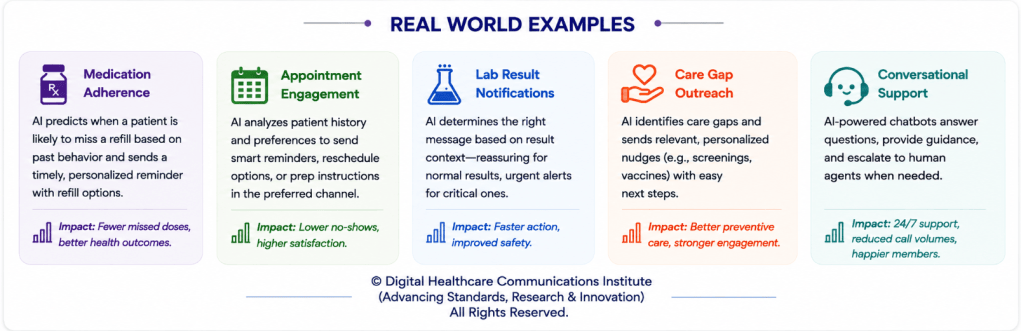
From Automated to Intelligent Communication
Automated messaging was a breakthrough not too long ago. It allowed healthcare organizations to communicate with millions of patients and members quickly and consistently. But automation largely answered one question—how to send a message at scale. It did not always answer the more important one—what is the right message to send?
Traditional automation relies heavily on predefined rules and triggers. This can sometimes result in irrelevant messages, missed context, repeated communication or information being delivered at the wrong time.
AI is beginning to change this. By understanding intent, context, behavior and previous interactions, communication can become more relevant, personalized and responsive.
We are already seeing this in healthcare—from AI helping patients navigate appointments and prescription refills to conversational assistants answering questions and directing people toward the appropriate next step.
The shift is simple but significant:
Automated Messaging → Understand Context → Predict Need → Intelligent Communication
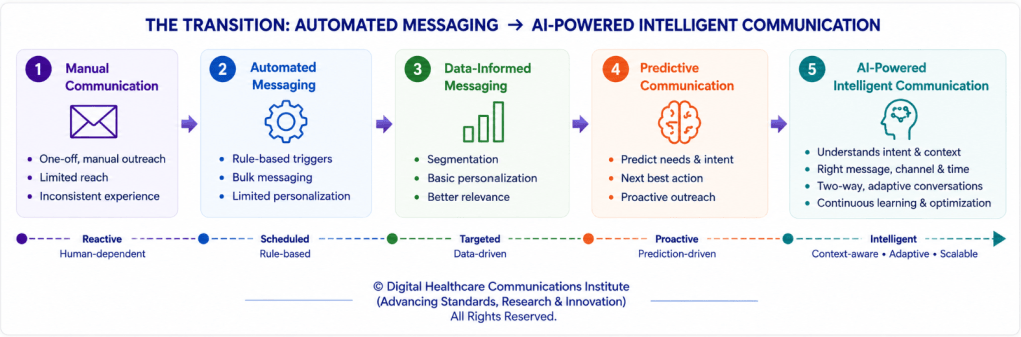
Personalization That Actually Matters
Personalization in healthcare communication goes far beyond adding “Hi, John” to a message. What truly matters is delivering the right information, at the right level, in the right context.
Too little information creates confusion; too much can overwhelm the patient and bury what actually matters. A simple prescription-ready message, for example, becomes far more useful when it includes the pharmacy name, location, pickup details and relevant next steps.
This is where AI can make a meaningful difference. By understanding context, preferences, previous interactions and individual needs, AI can help healthcare organizations personalize communications at scale—without simply adding more information.
True personalization isn’t about saying more. It’s about making every message more relevant and actionable.
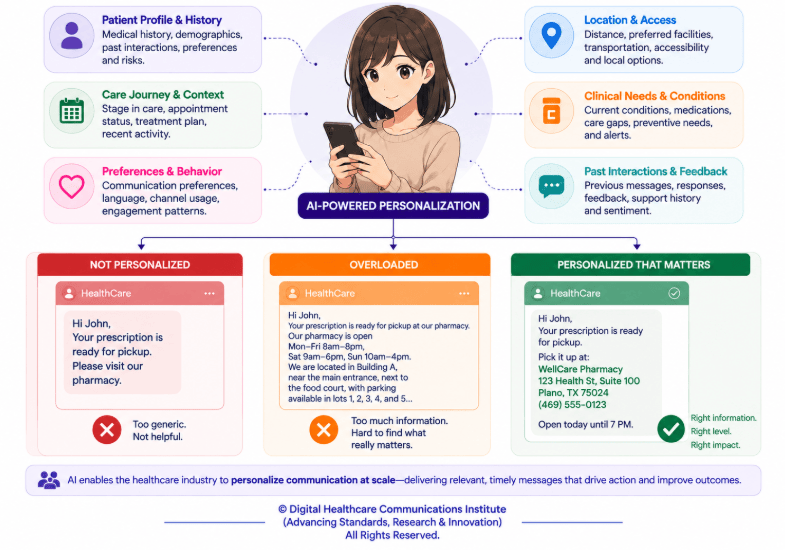
Right Message. Right Channel. Right Time.
As healthcare organizations add new ways to reach customers—email, SMS, push, RCS, apps and more—it is tempting to consider every new touchpoint a win.
But look at it from the customer’s perspective. That same person is already managing communications from pharmacies, providers, health plans and numerous other organizations. Another channel doesn’t necessarily mean a better experience.
The smarter approach is to understand where and when a customer is most likely to engage, and then deliver a relevant message through that channel at the right moment.
AI and machine learning can help make this possible at scale—learning from communication preferences, past interactions, engagement patterns and timing to determine the right message, right channel and right time for each individual.
Without that intelligence, you may know which direction to shoot—but you don’t necessarily know where the bull’s-eye is.
Modern healthcare communication shouldn’t be about adding more touchpoints. It should be about making every touchpoint count.
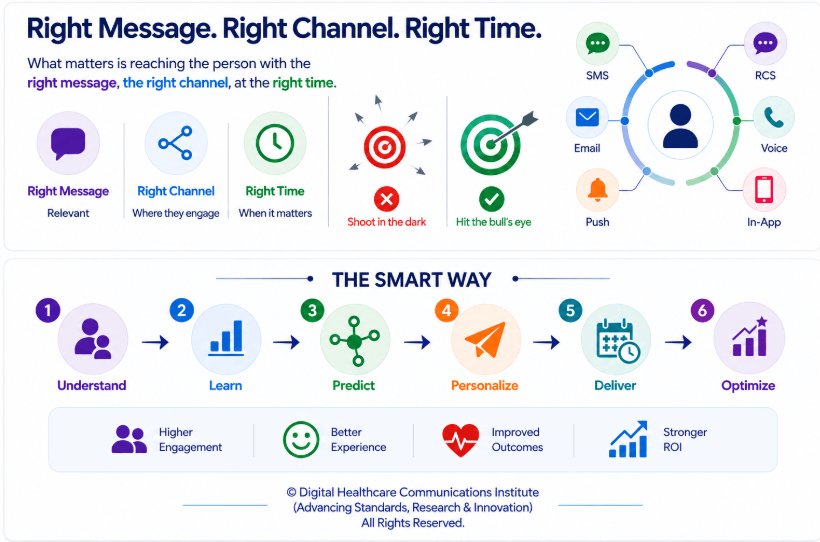
Predictive & Conversational Communication
For years, healthcare communication has largely been reactive. A prescription becomes due, a refill reminder is sent. An appointment approaches, a reminder is triggered. A claim gets processed, a notification follows. The communication happens because something has already happened.
Predictive communication changes that equation.
With AI and machine learning, organizations can use behavioral patterns, past interactions and available context to anticipate what a patient or member may need next. Instead of waiting for someone to miss a refill, miss an appointment or call for help, communication can happen at a point where it has a better chance of making a difference.
But prediction alone is not enough. Communication also needs to become a conversation.
Imagine receiving a refill reminder and being able to respond, “I don’t need this medication anymore,” or an appointment reminder with “I can’t make this time.” Instead of ending there, an intelligent communication system understands the intent and guides the person toward the appropriate next step.
That is where predictive and conversational communication come together:
Anticipate the need → Start the right conversation → Understand the response → Guide the next action.
The future of healthcare communication should not simply be about informing people what has happened.
The smartest healthcare communication may be the one that reaches you before you realize you need it—and stays with you until the conversation is complete.
The Responsibility Behind AI-Powered Messaging
Communicating with members comes with great responsibility. Compliance, privacy, standardization, the right intent, appropriate frequency, personalization and channel selection—each is a foundation pillar in itself. Together, these pillars carry something healthcare organizations spend years building: trust.
That responsibility becomes even greater with AI. Members span different age groups, geographies, preferences, accessibility needs and stages of their healthcare journey. What works for one population may not work for another. This is why responsible AI-powered communication needs strong guardrails and clearly defined standards. Some principles can be universal, but many will need to reflect the organization, its members and the nature of the communication. There is no one-size-fits-all approach.
But this raises an interesting question.
What if there was a common framework to evaluate the quality and responsibility of healthcare communication?
Imagine a scoring model that a healthcare organization could adopt, customize to its environment, and use to identify gaps across areas such as privacy, compliance, personalization, frequency, channel selection, timing and overall communication effectiveness.
Instead of simply asking, “Was the message delivered?”, organizations could begin asking a much more meaningful question:
“How well did we communicate—and where can we do better?”
Perhaps the next evolution of AI-powered healthcare communication isn’t just about making messages more intelligent. It is about creating a measurable standard for responsible communication.


Leave a Reply