
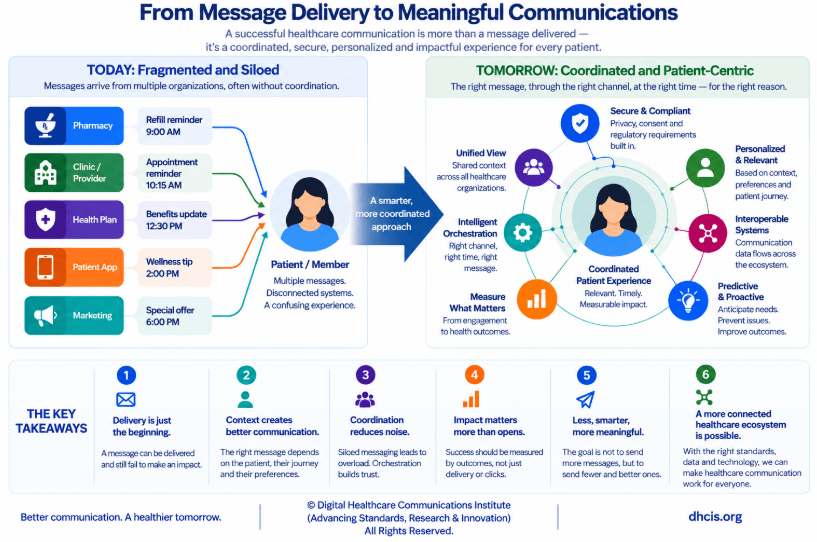
Organizations today often consider a healthcare communication successful when a message reaches the intended patient or member on time.
Message sent. Message delivered. Job done.
Unfortunately, that definition of success cannot be further from reality.
Having worked closely with large-scale digital communication ecosystems, I have seen that delivery is only one small part of a much larger journey. Behind a seemingly simple email, text message or push notification are layers of data, consent, preferences, business rules, personalization, channel selection, timing, compliance, security and measurement.
A message can be delivered successfully from a technology standpoint and still fail completely from a communication standpoint.
Was it relevant? Was it sent through the right channel? Was it sent at the right time? Did the member understand what action was expected? Was another part of the organization sending a conflicting message at the same time? Had the person already received several communications that day? Most importantly, did the communication actually accomplish what it was intended to do?
These are the questions that deserve much more attention.
Fragmented Communication
A typical healthcare consumer doesn’t interact with just one organization or one system.
Think about a person managing a prescription while also seeing a physician and being covered by a health plan. Within a relatively short period, that person could receive communications from a pharmacy, physician’s office, hospital, insurer, patient portal, wellness program and healthcare app.
Each communication may be perfectly valid on its own.
The problem is that these systems rarely know what the others are communicating.
A pharmacy may send a refill reminder. A health plan may send a medication-adherence message. A provider may send an appointment reminder. A marketing platform may send a wellness campaign—all within the same day.
From the organization’s perspective, four systems successfully delivered four messages.
From the consumer’s perspective, it may simply feel like healthcare organizations will not stop messaging them.
That is the difference between message delivery and communication orchestration.
Channel-Centric Rather Than Consumer-Centric
Healthcare organizations have invested heavily in email, SMS, mobile apps, push notifications, patient portals and, increasingly, newer channels such as RCS.
But these channels are often managed independently.
The email team optimizes email. The SMS team optimizes text messages. The mobile team focuses on push engagement. Marketing teams optimize campaigns. Operational teams concentrate on transactional communications.
The consumer, however, does not see these organizational boundaries.
They simply see messages from the same healthcare organization.
The real question therefore shouldn’t always be:
“What is the best email we can send?”
It should be:
“What is the best communication we can deliver to this person at this moment?”
Sometimes that answer may be email. Sometimes SMS. Sometimes push. And sometimes the best decision may be not to send another message at all.
Personalization Goes Beyond Adding a Name
Personalization is another area where healthcare communication has significant room to evolve.
Adding a patient’s first name to an email does not necessarily make the communication personalized.
True personalization requires context.
What communication channel does the person prefer? What interactions have already taken place? Is the communication relevant at this point in their healthcare journey? Has the person already completed the requested action? What language do they prefer? How frequently have they been contacted recently?
A highly personalized message delivered at the wrong time can still become an irrelevant message.
The future of healthcare communication therefore needs to move from content personalization toward communication personalization.
Limited Interoperability
Healthcare data is distributed across numerous systems—EHRs, pharmacy platforms, CRM systems, insurance platforms, marketing technologies, communication vendors, mobile applications and patient portals.
The communication layer often sits somewhere between all of them.
When these systems do not exchange information effectively, the communication experience becomes fragmented as well.
This can result in duplicate communications, outdated information, unnecessary reminders or messages that don’t reflect an action the consumer has already taken.
Interoperability should therefore not stop at exchanging clinical information. Communication context also needs to travel across the healthcare ecosystem.
Measuring Delivery Instead of Impact
Digital communication platforms give organizations an enormous amount of data:
- Delivered.
- Opened.
- Clicked.
- Bounced.
- Unsubscribed.
These metrics are useful, but they don’t necessarily tell us whether the communication was successful. Consider a medication refill reminder.
A 98% delivery rate looks excellent on a dashboard. But what if only a small percentage of recipients actually refill their medication?
Which metric represents success—the delivery rate or the outcome?
Healthcare communication measurement needs to gradually move beyond traditional messaging metrics toward communication effectiveness.
Did the patient take the intended action? Did the communication reduce missed appointments? Did it improve medication adherence? Did it eliminate an unnecessary call? Did it make the healthcare journey easier?
Those are much harder questions to answer, but ultimately they are the ones that matter.
Communication Overload Is Real
More communication does not necessarily mean better communication.
As organizations add more digital channels and automate more customer journeys, the ability to send messages becomes easier than ever.
That creates another problem: communication fatigue.
Imagine receiving a prescription reminder in the morning, an insurance email at noon, a wellness push notification in the afternoon and a promotional pharmacy message that evening.
Every message may individually satisfy the organization’s communication rules. Collectively, however, the experience may be overwhelming.
Over time, consumers may begin ignoring messages altogether—including the important ones.
Healthcare organizations therefore need to think beyond campaign-level frequency limits and consider the total communication load placed on an individual across the enterprise.
Reactive Rather Than Predictive
Most healthcare communications today are triggered by something that has already happened.
- A prescription is ready.
- An appointment is approaching.
- A claim has been processed.
- A medication refill is due.
These communications are important and will continue to be necessary.
But the next evolution of digital healthcare communication will increasingly involve anticipating what a consumer may need before the need becomes obvious.
With responsible use of data, analytics and AI, communication systems could potentially identify when a consumer is likely to miss an appointment, abandon a refill, become disengaged or require additional guidance.
The goal should not be to send more messages.
The goal should be to send fewer, smarter and more meaningful messages.
We Need to Redefine “Successful Delivery”. Digital healthcare communication has evolved enormously, but the way we measure its success needs to evolve with it.
A message reaching someone’s phone or inbox should not be the finish line.
Successful healthcare communication should mean that the message was delivered securely, compliant with applicable requirements, relevant to the recipient, coordinated with other communications, delivered through an appropriate channel and ultimately useful to the person receiving it.
As healthcare becomes more digital, connected and AI-driven, communication needs to evolve from a collection of independent messaging channels into a coordinated discipline.
Perhaps the most important shift is also the simplest:
Stop measuring how successfully we send messages and start measuring how successfully we communicate.
What do you feel about Message success, what are the parameters that are being ignored today in defining the parameters of success? Let us know your thoughts in the comments below.


Leave a comment