
Before attempting to answer that question, it is worth taking a step back and considering the sheer scale of digital health communications across the United States. Every day, billions of interactions take place through emails, text messages, patient portals, mobile apps, push notifications, pharmacy alerts, appointment reminders, and health plan communications. These messages have become an integral part of how patients, consumers, providers, pharmacies, and healthcare organizations stay connected.
Surprisingly, despite its critical role, there is no centralized national framework that measures or tracks the overall volume of digital healthcare communications across all channels. While government agencies and healthcare organizations publish data on patient portals, digital health adoption, and healthcare utilization, the broader digital communications ecosystem remains fragmented, with no single source providing a complete picture.
To me, this highlights a larger issue. Digital Health Communications continues to operate behind the scenes—essential to the functioning of modern healthcare, yet often overlooked as a strategic discipline. Information on messaging standards, governance, security, privacy, compliance, communication architecture, and best practices is scattered across multiple regulations, vendors, and organizations.
“It is time for Digital Health Communications to be recognized as a core pillar of healthcare innovation rather than simply a supporting function.”
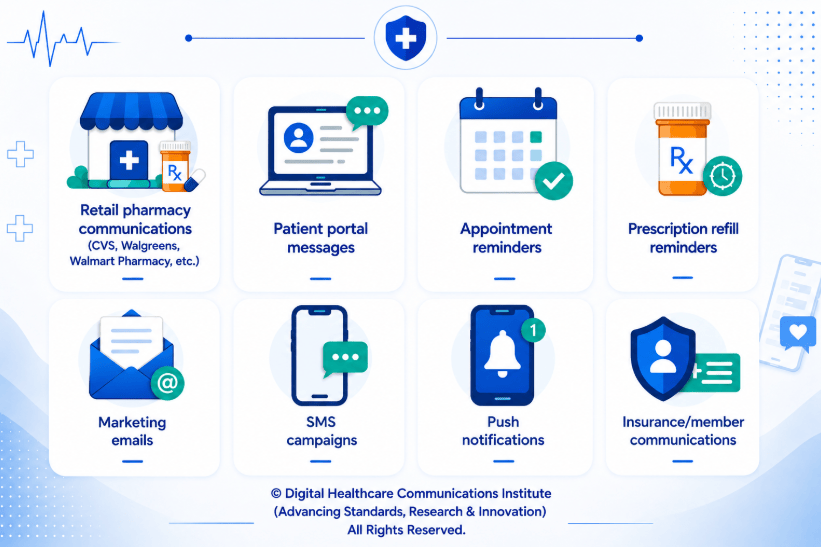
Broad Categories of Digital Health Communications
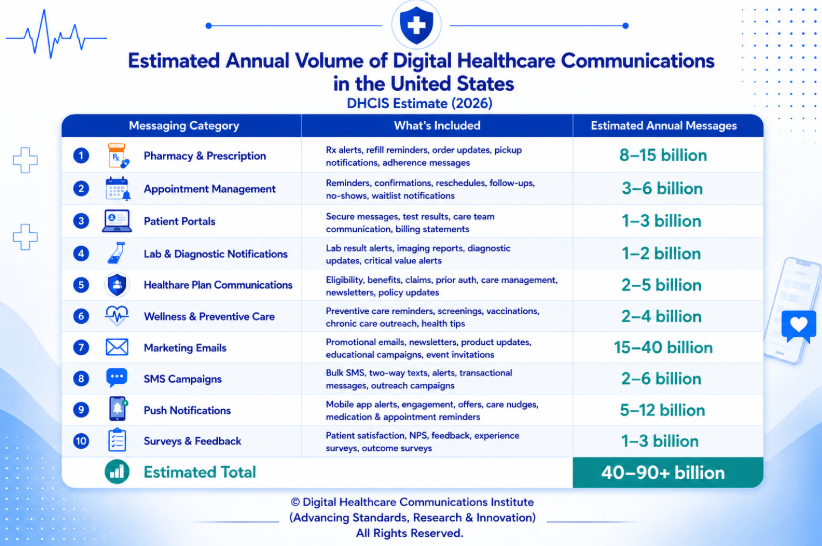
Rough Estimate of Total Messaging Volume
Putting the Numbers into Perspective
Based on the estimates presented above, it is reasonable to assume that nearly 70 billion digital healthcare communications are exchanged across the United States every year. While this is a research-based estimate rather than an official national figure, it highlights the enormous scale of digital messaging in healthcare.
That’s nearly 192 million messages every day—from prescription refill reminders and lab results to appointment notifications, insurance updates, wellness campaigns, and pharmacy promotions. Behind every message is a person depending on timely, accurate, and secure communication.
At this scale, Digital Health Communication is no longer just a technology or marketing function—it is a critical pillar of modern healthcare. Yet the field still lacks consistent standards, governance, and a unified approach to privacy, security, and communication quality.
As healthcare becomes increasingly digital and AI-driven, the need for stronger standards, better governance, and greater protection of consumer information has never been more important. Healthcare is only as effective as the communication that connects it.
Let us know your thoughts below in the comments box. Is Digital Healthcare Messaging really under-rated?
 Digital Healthcare Communications Institute
Leave a comment